
shopping_bag Cart Items (0)
₹0.00
remove_shopping_cart
Your procurement cart is empty
Browse Spares Catalog
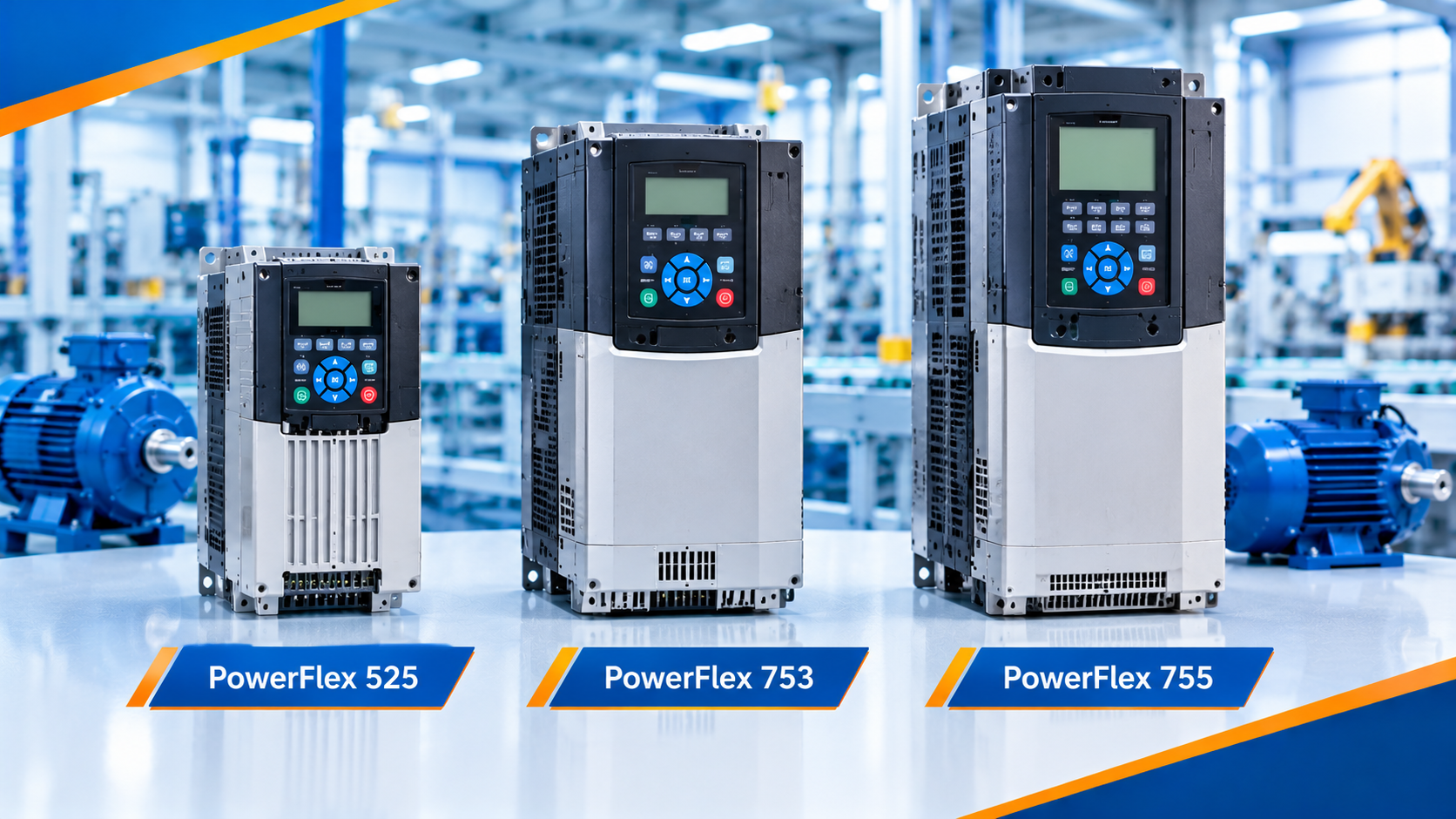
Choosing the right Variable Frequency Drive (VFD) keeps production lines running smoothly and avoids wasted budget. A VFD controls an electric motor's speed, torque, and direction by varying the frequency and voltage sent to it.
Allen-Bradley drives are popular across industrial plants. Three modern workhorses dominate today: the PowerFlex 525, PowerFlex 753, and PowerFlex 755.
Although all three control motors, they serve different power ranges, safety needs, and control architectures. In this PowerFlex 525 vs PowerFlex 753 vs PowerFlex 755 comparison guide, we break down their performance, network integration, and practical use cases.
Let's look at where each drive fits best before comparing technical features.
The PowerFlex 525 is a compact, modular drive built for stand-alone machines and simple networked systems. It comes with built-in Dual-Port EtherNet/IP for easy daisy-chain wiring.
Power Range: 0.4 kW to 22 kW (0.5 HP to 30 HP)
Control Type: Volts per Hertz, Sensorless Vector, and Permanent Magnet Motor Control
Best For: Conveyors, fans, pumps, and standalone machine tools.
The PowerFlex 753 belongs to the PowerFlex 750-Series. It provides general-purpose control for larger applications that need safety options, flexible expansion cards, and higher horsepower.
Power Range: 0.75 kW to 270 kW (1 HP to 400 HP)
Control Type: Volts per Hertz, Sensorless Vector, and Flux Vector Control
Best For: Heavy crushers, large pumps, extruders, and material handling systems.
The PowerFlex 755 is the flagship high-performance drive of the 750-Series. It handles high power ratings and integrates seamlessly into Rockwell Studio 5000 using CIP Motion (Control and Information Protocol Motion).
Power Range: 0.75 kW to 1500 kW (1 HP to 2000 HP)
Control Type: Volts per Hertz, Vector Control, and Integrated Motion on EtherNet/IP
Best For: High-speed web handling, coordinated multi-axis machinery, metal processing, and heavy cranes.

To select the right drive, you must understand key differences in hardware and network features:
PowerFlex 525: Features built-in dual EtherNet/IP ports on the main control module. This simplifies wiring without needing extra communication cards.
PowerFlex 753: Does not include built-in Ethernet. You must install an optional option module (like 20-COMM-E or 750-ENETR) into an expansion slot.
PowerFlex 755: Includes an embedded Ethernet port specifically designed for high-speed network control and integrated motion tasks.
PowerFlex 525 & 753: Operate as standard drive devices. A PLC sends commands over I/O or network words, but the drive manages its own speed loop.
PowerFlex 755: Supports Integrated Motion on EtherNet/IP (CIP Motion). The ControlLogix or CompactLogix PLC controls the drive like a servo axis, enabling synchronized multi-axis movement.
PowerFlex 525: Features a two-piece design (Control Module and Power Module). This lets you configure control settings off-site via USB before plugging into power hardware.
PowerFlex 753: Contains 3 option slots for auxiliary I/O, encoders, safety cards, or fieldbus networks.
PowerFlex 755: Offers 5 option slots for maximum hardware customization in complex industrial systems.
| Feature | PowerFlex 525 | PowerFlex 753 | PowerFlex 755 |
| Max Power Rating | Up to 22 kW (30 HP) | Up to 270 kW (400 HP) | Up to 1500 kW (2000 HP) |
| Onboard Ethernet | Embedded Dual-Port | Optional Option Card | Embedded Ethernet Port |
| Option Slots | None (Fixed I/O) | 3 Slots | 5 Slots |
| CIP Motion Support | No | No | Yes |
| Integrated Safety | Built-in Safe Torque Off | Optional Safety Module | Optional Safety Module |
| USB Configuration | Yes (MainsFree) | Via HIM / Network | Via HIM / Network |
Consider a food processing and packaging factory with three distinct motor drives:
Infeed Sorting Belt: Needs a simple 3 HP motor connected over Ethernet. The PowerFlex 525 is ideal because built-in dual Ethernet ports save space and money.
Main Mixing Vessel: Requires a 100 HP motor with high starting torque and safe door interlocks. The PowerFlex 753 fits best because it handles large horsepower and allows custom safety option cards.
High-Speed Rotary Cartoner: Requires exact position synchronization between cutting knives and feeder belts. The PowerFlex 755 is required because CIP Motion provides precise position matching across axes.
Tip 1: Check Horsepower Limits First
If your motor exceeds 30 HP (22 kW), the PowerFlex 525 is out. Move directly to the PowerFlex 753 or 755.
Tip 2: Don't Forget the Ethernet Card for 753
A common mistake when ordering a PowerFlex 753 is forgetting to add an EtherNet/IP option module. Unlike the 525, it is not built-in.
Tip 3: Leverage USB Setup on the 525
You can program a PowerFlex 525 using a simple USB cable while the drive is still in its box without main 480V power applied.
Comparing the PowerFlex 525 vs PowerFlex 753 vs PowerFlex 755 comes down to three main points: horsepower, option flexibility, and motion control requirements.
Choose the PowerFlex 525 for small motors up to 30 HP when you want low costs and built-in dual Ethernet ports.
Choose the PowerFlex 753 for larger motors up to 400 HP needing flexible I/O and standard torque control.
Choose the PowerFlex 755 for massive power demands or when you need integrated CIP Motion control.
Which drive model do you use most in your plant? Share your thoughts or leave a question in the comments below!
Yes. The PowerFlex 525 is Rockwell Automation's primary compact drive solution, offering better network capabilities and safety compared to older PowerFlex 4-Series drives.
The PowerFlex 755 has an embedded Ethernet port, supports CIP Motion control, offers 5 option slots, and reaches up to 2000 HP. The 753 tops out at 400 HP, has 3 option slots, and lacks CIP Motion support.
Yes. The PowerFlex 525 includes built-in hardwired Safe Torque Off (STO) as standard, which helps meet modern machinery safety standards.
Yes. PowerFlex 525 drives integrate directly into Studio 5000 Logix Designer using Premier Integration profiles for fast configuration and monitoring.
Keep the site working: signing in, your cart and checkout, security checks and remembering these privacy choices. These cannot be switched off.
Remember products you viewed and searches you made so we can show "recently viewed" items and relevant suggestions, linked to your account when you sign in.
Help us understand how visitors use the site (pages visited, time spent, country) so we can improve it. Without this we only count anonymous daily totals.
Allow advertising, chat and notification partners to set cookies so we can measure campaigns, show relevant offers and offer live chat and push notifications.