
shopping_bag Cart Items (0)
₹0.00
remove_shopping_cart
Your procurement cart is empty
Browse Spares Catalog
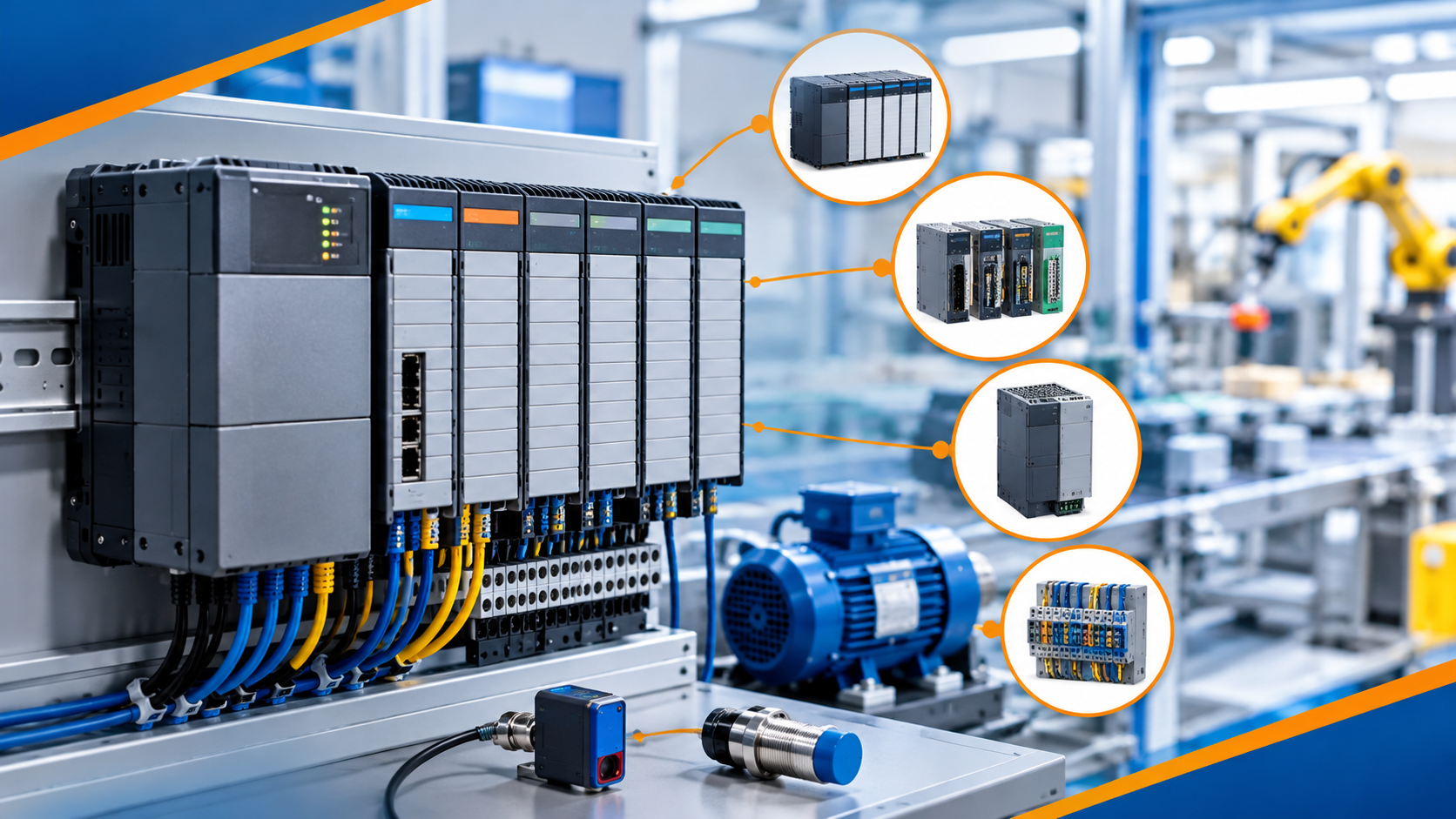
The Allen-Bradley 1746 I/O platform is one of the most reliable input and output hardware lines in industrial control history. Designed by Rockwell Automation, these modules serve as the physical eyes, ears, and hands of SLC 500 controllers and remote I/O racks. A Programmable Logic Controller (PLC) relies on I/O modules to talk to real-world devices like pushbuttons, valves, and sensors.
Whether you maintain older production equipment or troubleshoot factory cabinets, this Allen-Bradley 1746 Series: Modules, Compatibility & Applications guide gives you practical engineering knowledge. You will learn how 1746 modules work, how to check hardware compatibility, how to calculate rack power, and how to keep your systems running smoothly.
The Allen-Bradley 1746 Series is a family of modular expansion cards made for the SLC 500 system. Think of a PLC rack like a desktop computer. The main processor acts as the CPU, while the 1746 expansion cards act like USB ports or sound cards. They let the CPU communicate with outside devices on the factory floor.
1746 modules plug directly into the backplane of a 1746 chassis. The backplane is a printed circuit board inside the metal rack that carries power and data signals between all installed cards.
Modular Selection: Choose exact combinations of digital, analog, and specialty modules for any machine.
Rugged Construction: Built to endure heavy plant vibration, high electrical noise, and warm enclosure temperatures.
Removable Terminal Blocks (RTBs): Allows quick module swapping without unwiring individual field terminals.
Optical Isolation: Protects sensitive internal CPU electronics from high-voltage field spikes.

Rockwell Automation designed several categories of 1746 cards to handle different field signals. Understanding these categories makes troubleshooting fast and accurate.
Digital modules process discrete ON or OFF binary signals.
Digital Inputs (e.g., 1746-IB16, 1746-IA16): Read signals from limit switches, proximity sensors, and pushbuttons. They operate at common voltages like 24V DC or 120V AC.
Digital Outputs (e.g., 1746-OB16, 1746-OW16): Send power to energize motor starters, solenoid valves, and stack lights. Output types include transistor switching (DC), triac switching (AC), or mechanical relays (AC/DC).
Analog modules measure or send continuous variable signals rather than simple ON/OFF states.
Analog Inputs (e.g., 1746-NI4, 1746-NI8): Convert variable voltage (0-10V) or current (4-20mA) signals into numerical values inside the PLC. Used for level sensors, pressure transducers, and flow meters.
Analog Outputs (e.g., 1746-NO4I, 1746-NO4V): Send precise voltage or current commands to variable frequency drives (VFDs) and proportional control valves.
Specialty cards process complex signals directly on the card to save CPU processing time.
Thermocouple & RTD Cards (e.g., 1746-NT4, 1746-NR4): Read temperature sensors directly without using external signal transmitters.
High-Speed Counter Cards (e.g., 1746-HSCE): Track fast pulses from optical encoders on conveyor belts or motor shafts.
To build or maintain a working 1746 system, you must follow strict hardware configuration rules.
| System Parameter | 1746 Hardware Specification / Rule |
| Chassis Sizes | 4-Slot (1746-A4), 7-Slot (1746-A7), 10-Slot (1746-A10), 13-Slot (1746-A13) |
| Slot 0 Reservation | Slot 0 always holds the CPU or a Remote I/O Adapter (like the 1746-ASB). |
| Power Supply Mounting | Mounts on the far left of the chassis, outside the standard module slots. |
| Backplane Current Ratings | Supplied at 5V DC and 24V DC logic rails by the power supply. |
| Max Expansion Racks | Up to 3 chassis can be linked together using 1746 interconnect cables. |
Every card in a 1746 chassis consumes electrical current from the backplane. Before adding a module, add up the total 5V DC and 24V DC load of all installed cards.
If your modules demand more current than the power supply (such as a 1746-P1 or 1746-P2) can deliver, the rack will experience random system faults or hardware failure.
Consider a industrial chemical mixing process managed by a 1746 modular system.
Level Sensing: A 1746-NI4 analog input card reads a 4-20mA signal from a pressure transmitter. It tells the PLC the liquid depth in real time.
Temperature Control: A 1746-NT4 thermocouple module monitors the fluid batch temperature during heating.
Pneumatic Discharge: When the batch completes, the CPU signals a 1746-OW16 relay output card. The relay closes a contact to open a pneumatic dump valve.
Safety Interlock: A 1746-IB16 digital input card watches an emergency stop button. Pushing it instantly cuts power to the pump outputs.
This multi-module setup combines digital, analog, and temperature processing inside a single, reliable rack architecture.
Avoid these common operational mistakes when maintaining or replacing 1746 cards on the plant floor.
The 1746 chassis backplane does not support Removal and Insertion Under Power (RIUP). Always disconnect main electrical power before pulling or inserting cards. Swapping modules while powered can destroy the backplane or damage CPU memory.
Removable Terminal Blocks use small plastic keying pins. These pins stop technicians from accidentally plugging a 120V AC wiring block into a 24V DC input module. Never force a terminal block onto a card if it resists.
When replacing DC output cards, check if your field wiring requires sinking (1746-OBN) or sourcing (1746-OB16) modules. Sinking cards connect the load to ground (DC Common), while sourcing cards supply positive (+24V DC) power to the load.
The Allen-Bradley 1746 Series: Modules, Compatibility & Applications architecture remains a benchmark for modular control systems. By selecting the right digital, analog, or specialty cards, maintaining proper backplane power calculations, and observing key installation safety rules, engineers can maintain legacy machinery with total confidence.
Do you need help cross-referencing a 1746 I/O module or troubleshooting a backplane fault? Leave a comment below or contact our technical team at plchub.in today!
1746 modules work natively with Allen-Bradley SLC 500 processors (SLC 5/01 through 5/05). They can also be used as remote I/O racks connected to ControlLogix or CompactLogix controllers using a 1746-ASB adapter card.
The 1746-IB16 is a 24V DC sinking input module, meaning it receives current from field devices connected to positive power. The 1746-IV16 is a 24V DC sourcing input module, meaning it provides current out to sinking field devices.
If your 1746 power supply is overloaded, the processor may fail to boot, trip on major backplane faults, or experience unexpected brownouts when output points turn ON. Calculate your total module current draw using Rockwell datasheet ratings.
Yes. Most 1746 cards feature Removable Terminal Blocks (RTBs). You can unlatch and pull the entire wired block off the failed module, replace the module chassis card, and plug the original wiring block straight back in.
Keep the site working: signing in, your cart and checkout, security checks and remembering these privacy choices. These cannot be switched off.
Remember products you viewed and searches you made so we can show "recently viewed" items and relevant suggestions, linked to your account when you sign in.
Help us understand how visitors use the site (pages visited, time spent, country) so we can improve it. Without this we only count anonymous daily totals.
Allow advertising, chat and notification partners to set cookies so we can measure campaigns, show relevant offers and offer live chat and push notifications.