
shopping_bag Cart Items (0)
₹0.00
remove_shopping_cart
Your procurement cart is empty
Browse Spares Catalog
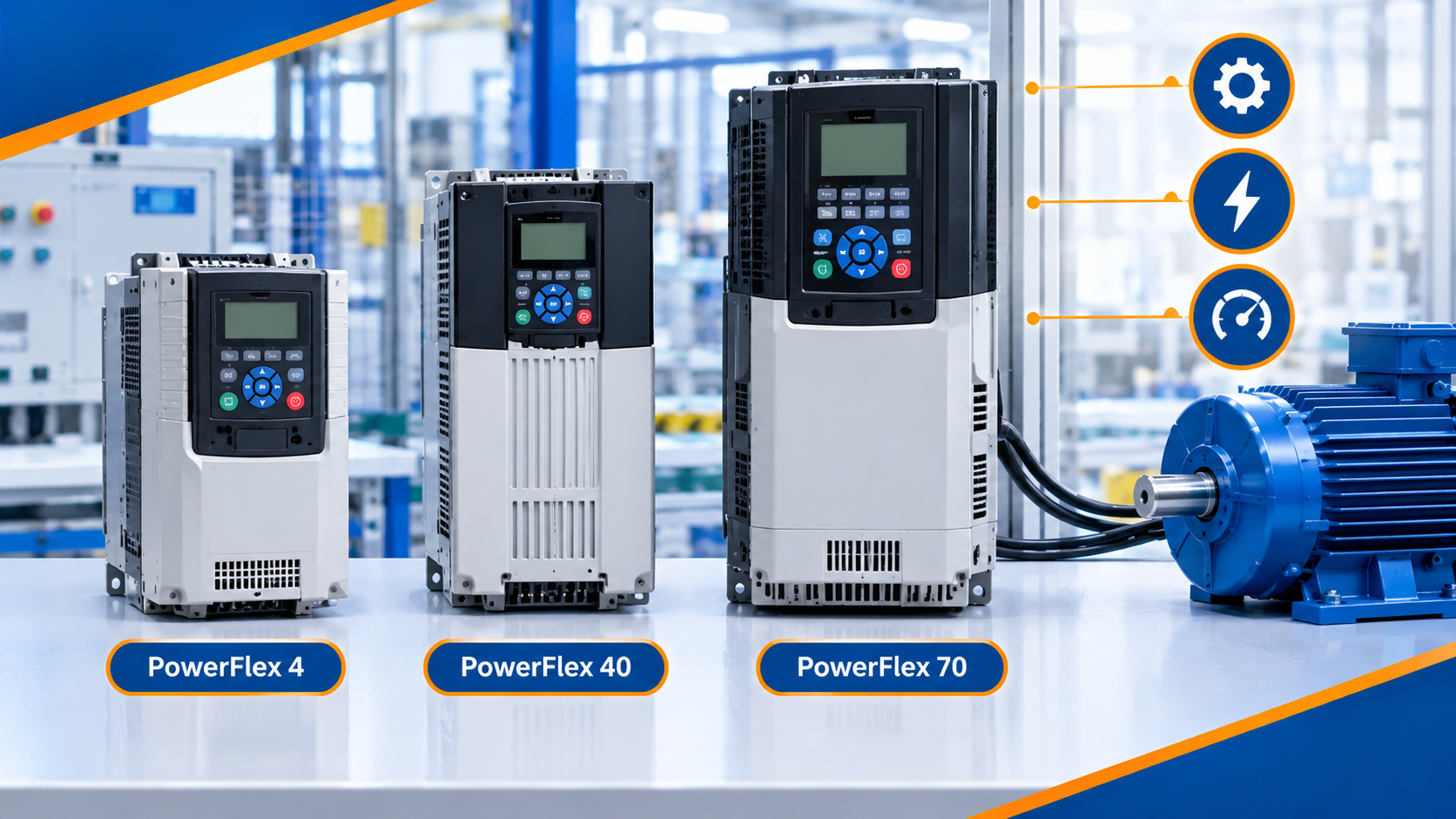
Choosing the right Variable Frequency Drive (VFD) can save you money and downtime. A VFD controls the speed, torque, and direction of an electric motor by changing the power frequency fed to it.
Allen-Bradley makes several popular VFD models. Three of the most common are the PowerFlex 4, PowerFlex 40, and PowerFlex 70.
While they look similar in pictures, they serve very different job requirements. In this PowerFlex 4 vs PowerFlex 40 vs PowerFlex 70 comparison guide, we break down their motor control modes, power ratings, networking capabilities, and real-world applications.
Before diving into details, let's establish what each drive does best.
The PowerFlex 4 is a basic, low-cost drive. It is designed for small machines that only need simple speed adjustments. Think of it like a light dimmer switch for a standard motor.
Power Range: 0.2 kW to 3.7 kW (0.25 HP to 5 HP)
Control Type: Volts per Hertz (V/Hz)
Best For: Small conveyors, simple fans, and basic pumps.
The PowerFlex 40 steps up the feature set. It adds better motor control, built-in dynamic braking options, and built-in process logic (StepLogic). Think of it as a smart thermostat that adjusts speeds automatically based on sensors.
Power Range: 0.4 kW to 11 kW (0.5 HP to 15 HP)
Control Type: Volts per Hertz and Sensorless Vector Control
Best For: Packaging machines, machine tools, and multi-speed process lines.
The PowerFlex 70 is an industrial-grade drive built for heavy work. It offers full vector control, safety functionality, and advanced communication modules. It is like a sports car engine tuner that manages speed and torque precisely.
Power Range: 0.37 kW to 37 kW (0.5 HP to 50 HP)
Control Type: Volts per Hertz, Sensorless Vector, and Flux Vector Control
Best For: Heavy mixers, extruders, web handling, and safety-critical machinery.

To select the right drive, you need to understand key technical terms:
Volts per Hertz (V/Hz): Keeps a fixed ratio between motor voltage and speed. It is simple but loses torque at low speeds. (Available on PF4, PF40, PF70).
Sensorless Vector Control (SVC): Estimates motor positions to keep full torque even at low speeds without needing an external speed sensor. (Available on PF40, PF70).
Flux Vector Control: Uses exact motor feedback (encoders) to deliver full holding torque at zero speed. (Available on PF70).
PowerFlex 4: Offers 3 fixed digital inputs and 2 programmable digital inputs. It has 1 analog input and 1 relay output.
PowerFlex 40: Adds 4 programmable digital inputs, 2 analog inputs, 1 analog output, and built-in PID control for automated feedback loops.
PowerFlex 70: Offers expanded option cards for custom I/O, advanced timer routines, and fast safety shutdown inputs.
Safety features let you stop motor rotation safely without cutting main power to the drive.
PowerFlex 4 & 40: Lack integrated Safe Torque Off (STO). You must use external power contactors to isolate motor power safely.
PowerFlex 70: Offers an optional DriveGuard Safe Off feature. This saves panel space and shortens restart delays after a safety stop.
| Feature | PowerFlex 4 | PowerFlex 40 | PowerFlex 70 |
| Max Power Rating | Up to 3.7 kW (5 HP) | Up to 11 kW (15 HP) | Up to 37 kW (50 HP) |
| Control Modes | Volts/Hertz | V/Hz, Sensorless Vector | V/Hz, Sensorless Vector, Flux Vector |
| Built-in PID Control | No | Yes | Yes |
| Onboard Network | RS-485 (Modbus RTU) | RS-485 (Modbus RTU) | DPI Option Adapters |
| Optional Adapters | DSI External Kit | EtherNet/IP, DeviceNet | EtherNet/IP, ControlNet, PROFIBUS |
| Integrated Safety | None | None | Optional Safe Torque Off |
| Enclosure Ratings | IP20 / Open | IP20, IP66 / NEMA 4X | IP20, IP66 / NEMA 4X |
Imagine you run a bottled beverage production line with three different drive needs:
Box Transfer Conveyor: The motor runs continuously at one set speed. Torque demands stay flat. The PowerFlex 4 is ideal here because you only need basic V/Hz speed control at the lowest cost.
Bottle Filling Station: A pump must maintain constant liquid pressure using feedback from a 4-20mA pressure transmitter. The PowerFlex 40 fits perfectly because it has a built-in PID controller to speed up or slow down the motor automatically.
High-Speed Capping Machine: High starting torque is required, and workers open safety guards frequently. The PowerFlex 70 is required because it delivers high torque at zero speed (Flux Vector) and features Safe Torque Off for worker safety.
Mistake 1: Undersizing the Drive for High Starting Loads
V/Hz drives like the PowerFlex 4 struggle when starting heavy, sticky loads like full mixers. If you have high breakaway torque requirements, choose a PowerFlex 40 or 70.
Mistake 2: Ignoring Line Reactors on Long Cable Runs
Long wires between a drive and motor create voltage spikes. Always install a line reactor if your motor leads exceed 100 feet (30 meters) to protect motor insulation.
Mistake 3: Mounting Drives Too Close Together
Drives generate heat. While PowerFlex drives support Zero-Stacking at lower ambient temperatures, always double-check the user manual for spacing guidelines to avoid thermal trips.
Choosing between the PowerFlex 4 vs PowerFlex 40 vs PowerFlex 70 comes down to three factors: motor size, control precision, and safety needs.
Choose the PowerFlex 4 for small, simple motors running open-loop applications.
Choose the PowerFlex 40 if you need PID control, extra I/O, or better low-speed torque.
Choose the PowerFlex 70 when you need larger motor horsepower, encoder feedback, or integrated safety options.
What drive series are you using in your plant? Leave a comment below or share your experiences with us!
Yes, in most physical mounting setups. The PowerFlex 40 covers the same power levels as the PowerFlex 4. However, you must verify parameter settings and wiring because the PowerFlex 40 has extra digital terminals.
No. The PowerFlex 40 uses Sensorless Vector Control. It calculates motor position using voltage and current signatures without needing an external speed encoder.
The PowerFlex 70 supports higher horsepower ratings (up to 50 HP), encoder-based Flux Vector control, integrated Safe Torque Off options, and expanded communication adapters.
Yes. The PowerFlex 70 accepts direct DPI EtherNet/IP cards. The PowerFlex 40 supports EtherNet/IP through optional communication adapters. The PowerFlex 4 requires an external DSI communications kit.
Keep the site working: signing in, your cart and checkout, security checks and remembering these privacy choices. These cannot be switched off.
Remember products you viewed and searches you made so we can show "recently viewed" items and relevant suggestions, linked to your account when you sign in.
Help us understand how visitors use the site (pages visited, time spent, country) so we can improve it. Without this we only count anonymous daily totals.
Allow advertising, chat and notification partners to set cookies so we can measure campaigns, show relevant offers and offer live chat and push notifications.