
shopping_bag Cart Items (0)
₹0.00
remove_shopping_cart
Your procurement cart is empty
Browse Spares Catalog
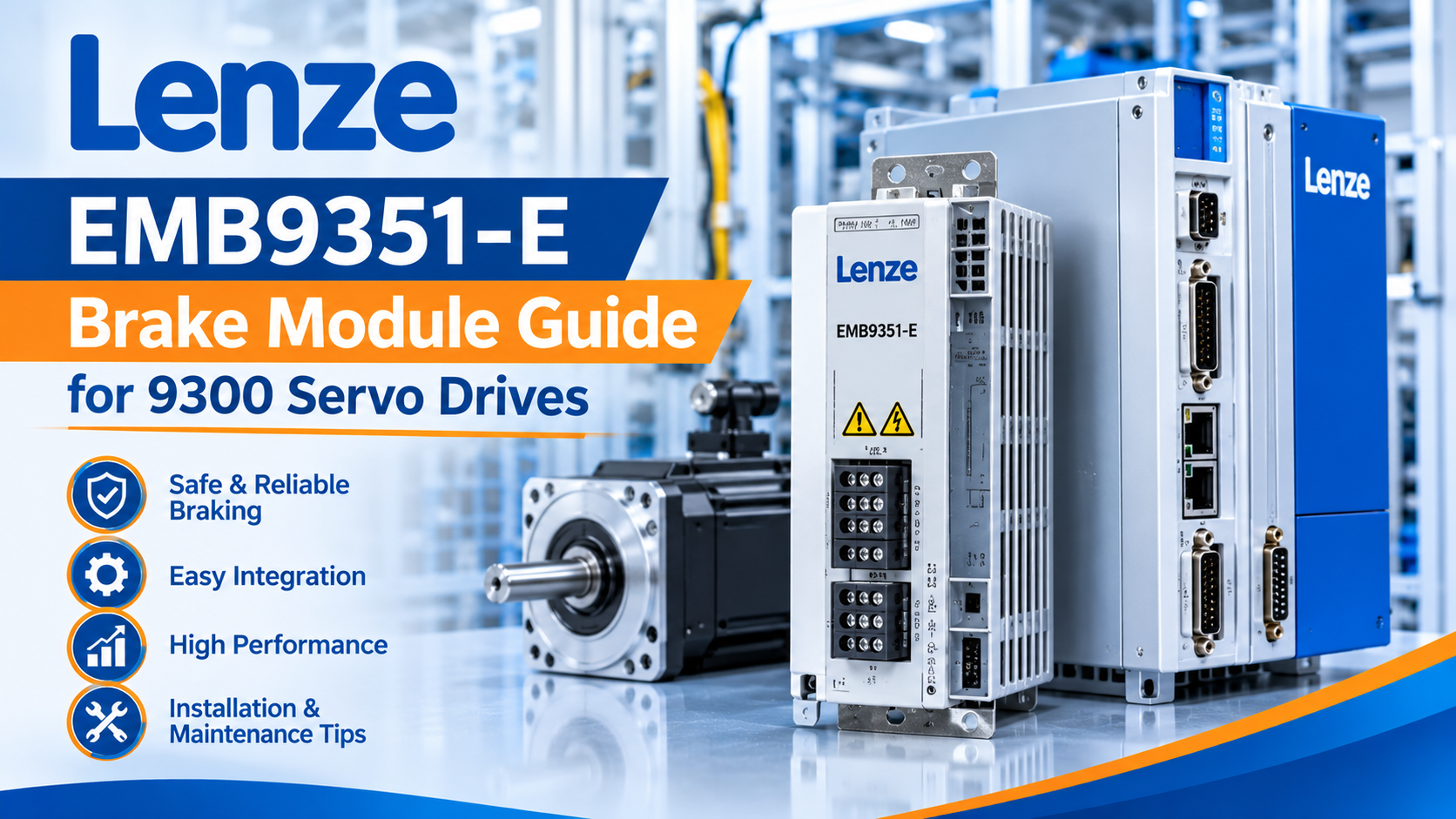
When an electric motor stops quickly or lowers a heavy load, it acts like a generator. Instead of consuming power, the motor pumps electrical energy back into the drive system. This returned electricity raises the DC bus voltage inside the servo drive. If the voltage climbs too high, the drive will shut down with an overvoltage fault.
A braking chopper solves this problem by safely absorbing and dissipating that excess energy. The Lenze EMB9351-E Brake Module Braking Chopper for 9300 Servo Drives is an external module designed by Lenze to manage regenerative energy in high-performance applications. In this guide, you will learn how this brake module works, its core specifications, proper wiring guidelines, and troubleshooting tips.
The Lenze EMB9351-E Brake Module Braking Chopper for 9300 Servo Drives is an electronic switching device. Think of it like the pressure relief valve on a steam boiler. When pressure (or voltage) gets too high, the valve opens briefly to release the excess safely.
When the internal DC bus voltage of a Lenze 9300 servo drive exceeds a safe threshold, the EMB9351-E module switches on. It redirects the surplus electrical energy away from sensitive drive electronics and into an external braking resistor, which converts the electrical energy into harmless heat.
| Parameter | Technical Specification / Rating |
| Catalog Number | EMB9351-E |
| Compatible Drive Family | Lenze 9300 Servo and Vector Drive Series |
| Module Type | External Braking Chopper / Transistor Switch |
| Cooling Method | Natural convection / Chassis heat sink mounting |
| Terminal Connections | DC bus links (UG+, UG-) and external resistor terminals (BR1, BR2) |
To understand why a braking chopper is necessary, it helps to examine the energy flow inside a servo system.
When a servo motor accelerates or pushes a load forward, electrical power flows from the AC supply, through the drive rectifier, into the DC bus, and out to the motor windings.
When the motor decelerates rapidly or lowers a vertical load (like an elevator or hoist), gravity or inertia forces the motor to spin faster than the commanded speed. The motor turns into a generator.
The generated electrical power flows backward into the drive's DC bus capacitors. Without a braking chopper, the capacitors overcharge instantly. The EMB9351-E detects this voltage spike, opens its internal switching transistor, and routes the current through an external resistor bank where it dissipates as heat.
Proper installation ensures safe operation and prevents damage to sensitive servo electronics.
Mount the EMB9351-E module directly inside your electrical control cabinet, ideally adjacent to the Lenze 9300 servo drive. Ensure adequate vertical clearance above and below the unit for natural heat dissipation.
Connect heavy-gauge DC bus cables from the drive terminals (UG+ and UG-) directly to the corresponding DC input terminals on the EMB9351-E module. Keep wire lengths as short as possible to minimize electrical noise and voltage drop.
The EMB9351-E acts as the switch, but it requires an external braking resistor to absorb the heat. Ensure your resistor's Ohm value meets Lenze minimum resistance specifications and its Wattage rating matches your application's duty cycle.
Consider a high-speed vertical lifting hoist driven by a Lenze 9300 servo system.
The Challenge: Every time the hoist lowers a heavy pallet, gravity drives the motor. The regenerated electrical energy spikes the DC bus voltage, tripping the drive on an F02 overvoltage fault.
The Solution: Engineers install a Lenze EMB9351-E Brake Module Braking Chopper for 9300 Servo Drives connected to an external wire-wound resistor bank.
Execution: During descent, the EMB9351-E detects the bus voltage rise, switches on instantly, and bleeds the excess regenerative energy into the resistor.
Result: Smooth, continuous vertical lowering without nuisance drive shutdowns or overvoltage trips.
Avoid these frequent errors when installing or maintaining industrial brake modules:
Using Undersized Resistor Wires: Braking resistors get extremely hot during operation. Always use high-temperature, insulated copper wire rated for industrial power enclosures.
Ignoring Thermal Switches: Always wire the thermal overload switch of your external braking resistor into the drive's control interlock circuit. If the resistor overheats, the system should stop immediately to prevent fire hazards.
Checking Fault Codes: If the drive still faults on overvoltage despite having a brake module, inspect the wiring continuity between the drive DC bus and the EMB9351-E terminals (UG+ / UG-).
The Lenze EMB9351-E Brake Module Braking Chopper for 9300 Servo Drives is an essential hardware addition for demanding motion control applications. By safely absorbing and dissipating regenerative energy, it prevents overvoltage faults and keeps production lines running smoothly. Proper module sizing, short DC bus wiring, and correct resistor pairing ensure reliable performance.
Do you have questions about sizing Lenze braking modules or troubleshooting servo drive overvoltage faults? Leave a comment below or reach out to our engineering support team at plchub.in today!
The EMB9351-E is a braking chopper module that switches excess regenerative energy from the DC bus into an external braking resistor, preventing drive overvoltage faults.
This module is designed specifically to interface with the Lenze 9300 servo and vector drive controller family.
No. The EMB9351-E contains the electronic switching transistor (chopper), but it requires an external braking resistor bank to dissipate the thermal energy.
An overvoltage fault occurs when the motor decelerates too quickly or lowers an overhauling load, pumping more energy into the DC bus than the capacitors can absorb.
Keep the site working: signing in, your cart and checkout, security checks and remembering these privacy choices. These cannot be switched off.
Remember products you viewed and searches you made so we can show "recently viewed" items and relevant suggestions, linked to your account when you sign in.
Help us understand how visitors use the site (pages visited, time spent, country) so we can improve it. Without this we only count anonymous daily totals.
Allow advertising, chat and notification partners to set cookies so we can measure campaigns, show relevant offers and offer live chat and push notifications.