
shopping_bag Cart Items (0)
₹0.00
remove_shopping_cart
Your procurement cart is empty
Browse Spares Catalog
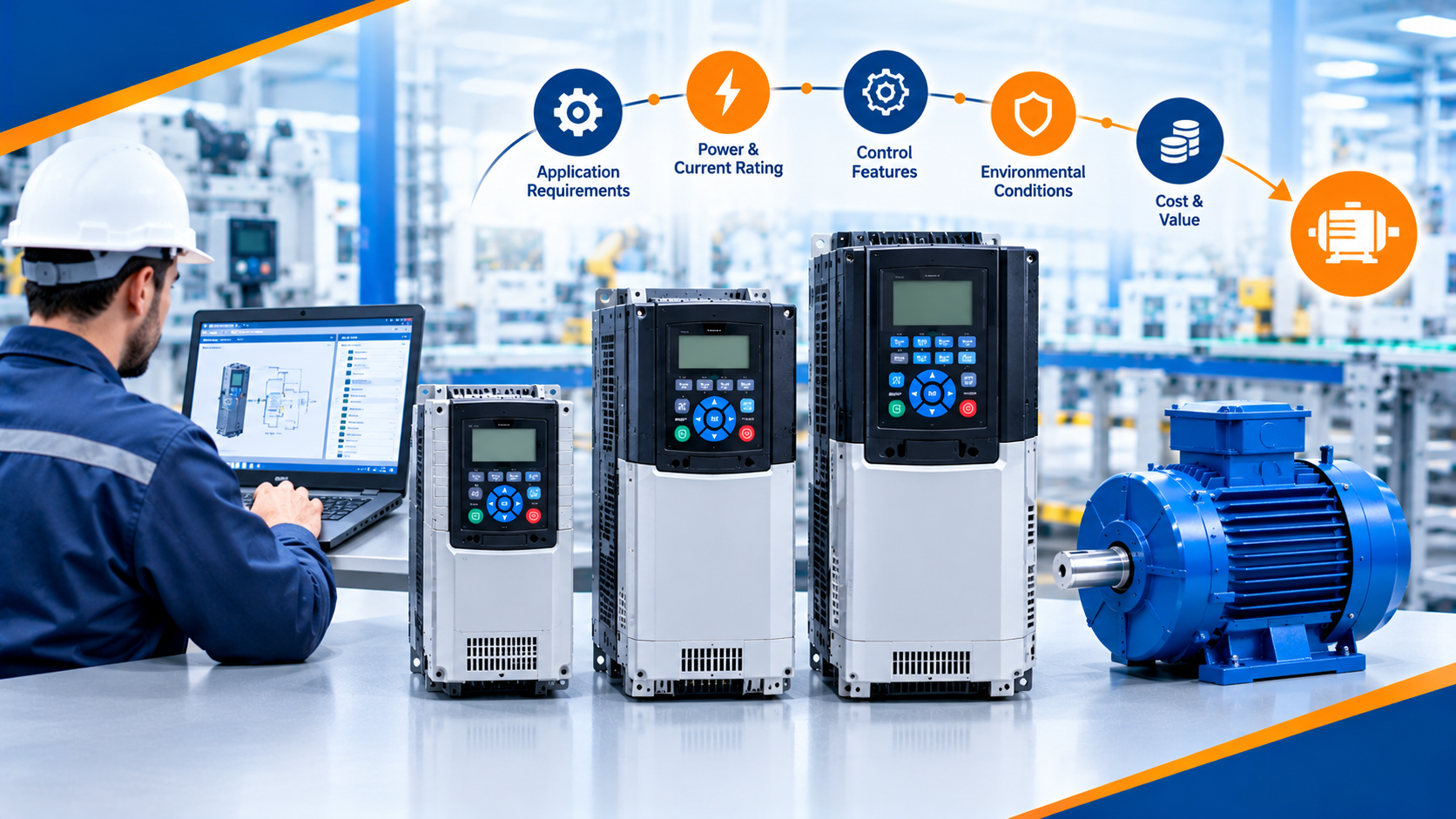
Variable Frequency Drives (VFDs) are essential components in modern industrial control systems. A VFD is an electronic device that controls the speed, torque, and acceleration of an electric AC motor by varying the frequency and voltage supplied to it. In Rockwell Automation environments, the PowerFlex family is the industry-standard choice for AC drive control.
Choosing the wrong drive can cause frequent tripping, motor overheating, or unnecessary expense. In this guide on How to Select the Right Allen-Bradley PowerFlex Drive, you will learn how to evaluate motor nameplate data, match duty ratings, select control modes, and pick the best PowerFlex series for your application.
Rockwell Automation categorizes its PowerFlex drives into two main functional classes: Compact drives and Architecture drives.
Compact drives are designed for standalone machines and simple motor control applications. They feature a space-saving design and easy DIN-rail mounting.
PowerFlex 523: Ideal for basic standalone machines requiring cost-effective speed control without complex networking.
PowerFlex 525: Includes built-in dual-port EtherNet/IP, Safe Torque-Off (STO) safety functions, and closed-loop velocity control options.
PowerFlex 527: Built specifically to integrate natively with Studio 5000 motion instructions alongside Kinetix servo drives.
Architecture drives handle complex, high-power, or heavy industrial process applications requiring advanced control and expansion slots.
PowerFlex 753: Excellent for general-purpose applications needing extra option cards for I/O, safety, or fieldbus communications.
PowerFlex 755: Designed for high-power applications, multi-axis coordinated motion, and advanced torque regulation over EtherNet/IP.
Follow these five steps when sizing and selecting a drive for any industrial application.
The single most common mistake in drive selection is sizing purely by motor Horsepower (HP) or Kilowatts (kW). Always select a drive based on the motor's Full Load Amps (FLA) rating printed on its physical nameplate.
Line voltage fluctuations, motor efficiency ratings, and pole counts alter the actual current draw. The drive's continuous output current rating must meet or exceed the motor nameplate FLA.
Verify the available supply power inside your electrical enclosure:
Single-Phase Input: Common in smaller facilities (115V AC or 230V AC input, stepping up to 230V 3-phase output).
Three-Phase Input: Standard industrial power (230V AC, 480V AC, or 600V AC).
Match the drive duty rating to the mechanical requirements of the machine load.
| Load Profile | Typical Application | Overload Requirement |
| Normal Duty (ND) | Variable torque loads: Fans, centrifugal pumps, blowers | 110% overload for 60 seconds |
| Heavy Duty (HD) | Constant torque loads: Conveyors, extruders, mixers, hoists | 150% overload for 60 seconds |
Choose a drive that supports the control algorithm needed for your motor:
Volts per Hertz (V/Hz): Basic speed control for fans and pumps. Allows multiple motors to run off one drive.
Sensorless Vector Control (SVC): Delivers high starting torque at low speeds without an encoder feedback device.
Flux Vector Control: Delivers precise speed and full torque control at zero speed using encoder feedback.
Determine how the controller will communicate with your PLC. Modern CompactLogix and ControlLogix systems use EtherNet/IP for seamless integration. If safety circuits are required, select models with built-in Safe Torque-Off (STO) to meet ISO safety compliance without adding external line contactors.

Consider a heavy manufacturing facility installing an industrial slurry mixer.
Motor Nameplate Data: 15 HP, 460V AC, 3-phase, 21.0 Amps FLA.
Application Type: Slurry mixing requires high starting torque when thick media settles. This is a Heavy Duty constant torque application.
Control Needs: Must communicate over EtherNet/IP to a CompactLogix processor and include Safe Torque-Off.
Drive Selection: A PowerFlex 525 rated for 15 HP Heavy Duty (24.0 Amps output rating) is selected. Sizing by FLA ensures the drive handles high starting friction without tripping on overcurrent faults.
Avoid these frequent engineering oversights during drive specification:
Sizing Oversized Motors on Long Cable Runs: Long motor cables create capacitive charge losses. If the distance between the drive and motor exceeds 100 feet (30 meters), install a reactor or dV/dt filter to protect motor windings from voltage spikes.
Ignoring Altitude and Ambient Temperature Derating: Drives installed at high altitudes (above 3,300 feet or 1,000 meters) or in hot control cabinets (above 50°C) must be derated in current capacity according to Rockwell published guidelines.
Forgetting Dynamic Braking Resistors: High-inertia stopping applications (like large centrifuges or saw blades) push regenerative energy back into the drive. Install a dynamic braking resistor to prevent Overvoltage (F005) faults during deceleration.
Knowing How to Select the Right Allen-Bradley PowerFlex Drive ensures high operational reliability and protects your plant machinery. By matching drive output current to motor FLA, evaluating Normal vs. Heavy Duty requirements, and selecting integrated EtherNet/IP connectivity, engineers can select the perfect drive for any application. Proper selection prevents nuisance tripping, lowers energy consumption, and simplifies machine integration inside Studio 5000.
Do you need help cross-referencing a PowerFlex catalog number or sizing a drive for a challenging motor application? Leave a comment below or reach out to our engineering team at plchub.in today!
The PowerFlex 525 includes an embedded dual-port EtherNet/IP port, closed-loop velocity control support, and embedded Safe Torque-Off safety, whereas the PowerFlex 523 uses serial communications and basic open-loop control.
Motor full load amps (FLA) represent the actual current the motor draws under load. Horsepower ratings are general estimates that do not account for pole counts, efficiency differences, or low-voltage conditions.
Safe Torque-Off removes rotational energy from the motor output terminals without disconnecting main line power to the drive. This allows fast, safe access to machinery while keeping the drive control electronics powered up.
Yes. Specific PowerFlex 520-series models accept single-phase 115V or 230V AC input power and generate a regulated 230V 3-phase output to run standard 3-phase AC motors.
Keep the site working: signing in, your cart and checkout, security checks and remembering these privacy choices. These cannot be switched off.
Remember products you viewed and searches you made so we can show "recently viewed" items and relevant suggestions, linked to your account when you sign in.
Help us understand how visitors use the site (pages visited, time spent, country) so we can improve it. Without this we only count anonymous daily totals.
Allow advertising, chat and notification partners to set cookies so we can measure campaigns, show relevant offers and offer live chat and push notifications.