
shopping_bag Cart Items (0)
₹0.00
remove_shopping_cart
Your procurement cart is empty
Browse Spares Catalog
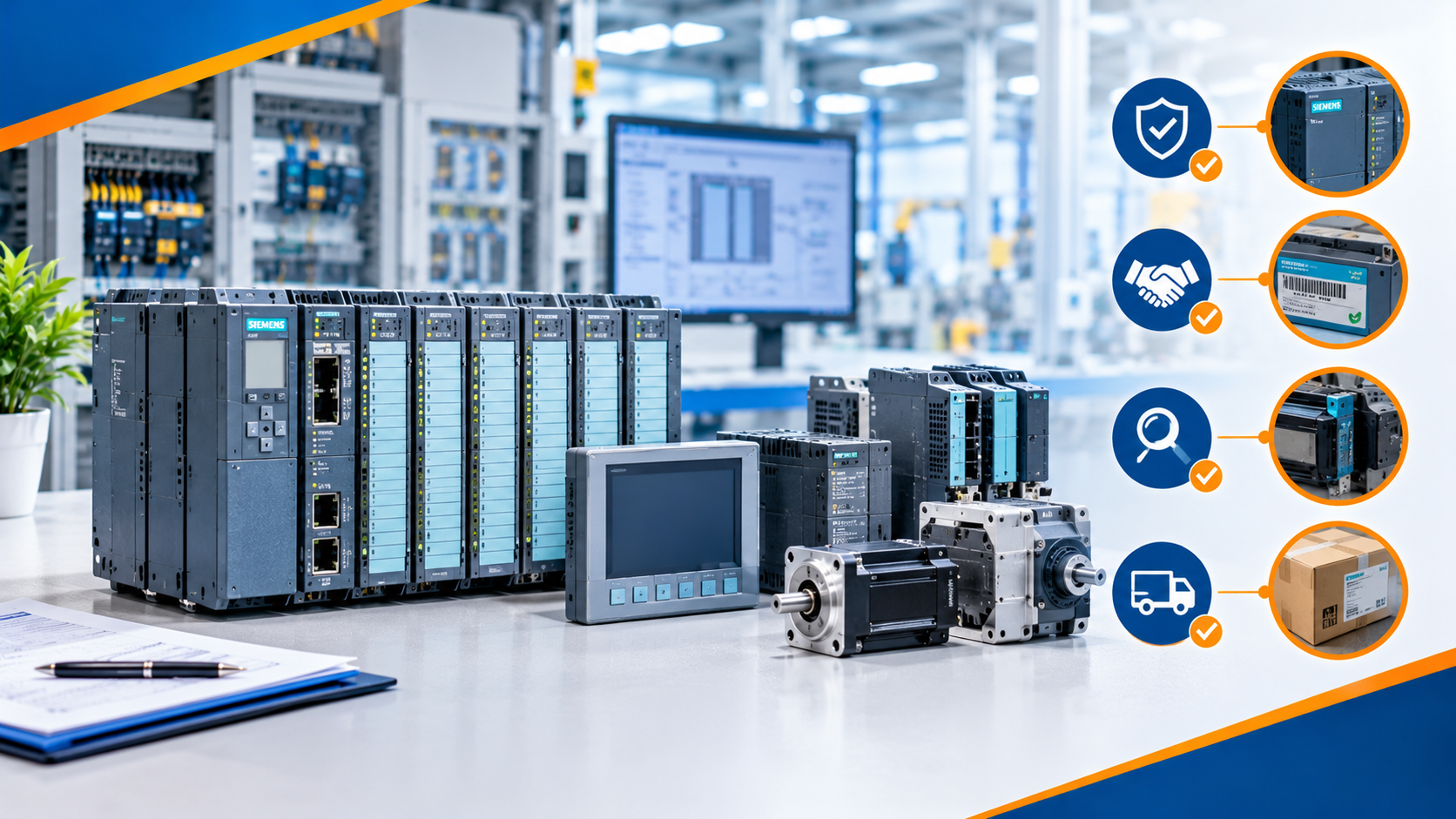
A cheap Siemens PLC is only a good deal if it is genuine, correctly identified, properly tested, and suitable for your application.
Industrial automation equipment is not something you want to gamble on.
A failed PLC, HMI, communication module, or drive can bring an entire machine or production line to a standstill. When an original component is obsolete or difficult to source, buying used or surplus Siemens automation parts can be a practical way to restore equipment while controlling replacement costs.
But there is a problem:
Not every product advertised as “genuine Siemens” is necessarily what the buyer expects.
Used, surplus, refurbished, repaired, obsolete, and counterfeit products can look very similar in online listings.
So how do you buy used Siemens industrial automation parts with confidence?
This guide explains what to check before purchasing used Siemens PLCs, HMIs, drives, CPUs, I/O modules, communication modules, power supplies and other Siemens automation equipment.
Siemens industrial automation equipment can remain in service for many years.
A factory may still be operating a machine built around an older Siemens S7-300 or S7-400 system even when newer PLC platforms are available.
Replacing the entire control system may require:
New hardware
New programming
Engineering time
Machine modifications
Testing and commissioning
Production downtime
Significant investment
In some situations, replacing one failed module with a compatible used or surplus unit can be much faster and more economical.
This is particularly important when a machine contains an obsolete or discontinued Siemens component.
Siemens itself provides spare-parts and lifecycle services because industrial equipment can reach the point where replacement parts are needed to prevent extended downtime.
The goal is buying the right part, from the right source, in the right condition.

This is the first and most important step.
Do not buy a Siemens PLC simply because the product name looks correct.
Siemens has many visually similar products with different technical specifications, firmware versions, communication interfaces, memory configurations, voltage ratings and hardware revisions.
For example, two products may both be described as an:
Siemens S7-300 CPU
but have completely different order numbers.
Complete Siemens order number
Product/model number
Hardware version
Serial number, where applicable
Firmware version, where relevant
Product photos
Nameplate photos
Connector/interface photos
The complete order number is much more useful than a generic description such as “Siemens S7-300 CPU.”
Siemens documentation also uses product and serial numbers to identify equipment and locate appropriate spare parts.
Send the supplier a photo of your existing part.
If possible, provide:
Part number + photo of nameplate + quantity required + application
This reduces the chance of ordering the wrong variant.
One of the biggest mistakes buyers make is assuming these words mean the same thing.
They don't.
A previously installed product that has been removed from service.
It may be fully functional, partially functional, untested, or faulty.
A product that is excess inventory or no longer required by the previous owner.
Surplus equipment may be:
New old stock
Open box
Unused
Previously stored
Previously installed
The exact condition must be confirmed.
A previously used product that has undergone some level of inspection, repair, restoration or testing.
However, “refurbished” does not automatically mean refurbished by Siemens.
Siemens' own refurbished products undergo a defined refurbishment and testing process and are restored to the original technical specifications and performance characteristics.
Therefore, when a supplier says:
“Siemens refurbished”
ask:
“Refurbished by whom?”
That single question can prevent a lot of confusion.
This is one of the easiest ways to filter suppliers.
If you are buying a used Siemens PLC, ask the seller for actual photos of the exact unit being supplied.
Don't rely only on a Siemens catalogue photograph.
Ask for photographs showing:
Check:
Siemens branding
Model identification
LEDs
Connectors
Physical condition
Scratches or damage
Check:
Labels
Connectors
Mounting points
Housing condition
Signs of modification
The nameplate should clearly show relevant identification information.
Where applicable, compare the information shown by the supplier with the product documentation and purchase records.
A single character can make a major difference.
For example, Siemens order numbers can contain detailed information about:
Product family
CPU type
Communication interface
Memory
Voltage
Hardware revision
Product configuration
Never assume that a visually similar replacement will work.
Copy the exact part number from your machine and send it to the supplier.
Then ask:
“Please confirm that the supplied unit is exactly this part number and provide a photograph of the nameplate.”
Get the confirmation in writing.
This is where many cheap deals fall apart.
A supplier saying:
“100% tested”
is not enough.
Ask what was tested.
For a PLC CPU, testing may involve appropriate power-up and functional checks, communication checks, diagnostics, and application-specific testing where feasible.
For an HMI, you may want to know whether the display, touchscreen, communication ports and power-up operation were checked.
For a drive, ask whether the unit has been tested for appropriate power-up, display/keypad operation, fault status and relevant functions.
The exact testing procedure will depend on the product.
“Can you provide a test report or test video for this unit?”
A serious supplier should be able to explain the testing process clearly.
Used industrial electronics can sometimes be repaired or modified during their previous life.
Look carefully for:
Broken seals
Missing screws
Damaged housings
Reworked circuit boards
Unusual soldering
Burn marks
Corrosion
Damaged connectors
Missing labels
Heavy cleaning or repainting
Mismatched labels
This doesn't automatically mean the product is bad.
A professionally repaired unit may still be useful.
The important thing is knowing what you are actually buying.
Siemens documentation also notes that certain authenticity/security labels are designed to indicate whether a component has been manipulated. Where such a label exists, a damaged label can be an important warning sign.
A used PLC may have:
Scratches
Faded labels
Minor discoloration
Stickers
Signs of previous installation
That doesn't necessarily mean it is defective.
Conversely, a product that looks almost new is not automatically genuine or functional.
Appearance is evidence of condition, not proof of functionality.
This is why testing matters.
Siemens' own refurbishment process distinguishes cosmetic restoration from functional testing and releases refurbished products only after they pass the applicable functional and quality tests.
Before buying a used Siemens automation component, ask:
A proper supplier should clearly explain:
Warranty period
DOA policy
Return conditions
Testing requirements
Replacement policy
Refund policy
Don't wait until after delivery to discover that the seller considers every used product:
“Sold as is.”
For critical automation components, warranty terms can be just as important as the purchase price.
A genuine-looking Siemens PLC from an unknown seller is still a risk.
Look at the supplier's:
Business history
Company website
Physical address
Product inventory
Customer reviews
Industry experience
Return policy
Warranty policy
Product photographs
Communication quality
Ask yourself:
Can I find this company again if there is a problem?
Siemens itself warns that products sourced through unknown or grey-market channels can carry risks including lack of expected support or warranty and the possibility of receiving used, damaged, non-functional or counterfeit products.
This is where procurement teams often make a costly mistake.
Imagine you receive three quotations:
| Supplier | Price | Testing | Warranty |
|---|---|---|---|
| Supplier A | ₹18,000 | Unknown | None |
| Supplier B | ₹21,000 | Tested | 30 days |
| Supplier C | ₹24,000 | Tested + documented | 90 days |
Supplier A looks cheapest.
But if the PLC fails after installation and causes several hours of machine downtime, that ₹3,000 or ₹6,000 saving can become meaningless.
Cheap hardware + machine downtime = expensive mistake.
Older Siemens automation systems can be difficult to replace with new equipment.
This creates demand for:
Used Siemens PLCs
Surplus Siemens modules
Obsolete Siemens CPUs
Used Siemens HMIs
Siemens communication modules
Siemens I/O modules
Siemens power supplies
Used Siemens drives
For these products, finding the correct original part number is critical.
If your machine depends on an obsolete component, replacing it with the wrong variant can create additional engineering work and downtime.
Instead of sending:
“I need a Siemens PLC. What is the price?”
send:
“I need Siemens 6ES7 XXXXXXX, quantity 2. Please quote your best price and confirm condition, testing status, warranty and availability.”
This immediately makes your inquiry more professional.
It also makes it easier for suppliers to provide an accurate quotation.
Before purchasing any used Siemens automation part, check these 10 points:
☐ Exact part number confirmed
☐ Actual product photos received
☐ Nameplate checked
☐ Serial/identification information reviewed
☐ Condition clearly stated
☐ Used/surplus/refurbished status confirmed
☐ Testing procedure explained
☐ Warranty confirmed
☐ Return/DOA policy confirmed
☐ Supplier identity and reputation checked
If several boxes remain unchecked, don't rush the purchase.
Absolutely.
Used and surplus industrial automation equipment can make sense when you need to:
Repair an existing machine
Replace an obsolete component
Reduce replacement costs
Maintain legacy equipment
Minimize production downtime
Keep an older automation system running
But the quality of the purchase depends heavily on identification, condition, testing and supplier reliability.
The objective isn't to find the cheapest Siemens PLC.
There are several ways to source Siemens automation equipment:
Best suited when you need new equipment, official support and manufacturer-backed purchasing.
Siemens offers refurbished automation products that have gone through its own refurbishment and testing processes.
These suppliers may have discontinued, surplus or used Siemens products that are difficult to source through conventional channels.
Specialized suppliers can be useful when you need a specific obsolete PLC, HMI, drive or module quickly.
At PLC HUB, we help businesses source new, used and surplus industrial automation equipment, including Siemens PLCs, CPUs, I/O modules, HMIs, drives and other automation components.
If you already know the part number, you don't need to search through hundreds of products.
We can check availability and provide a quotation based on the required product and condition.
Need a Siemens part?
Send Part Number → Get a Quote
Buying used Siemens industrial automation parts doesn't have to be risky.
The biggest mistake is treating a used PLC like an ordinary electronic component.
It's part of a machine's control system.
Take the time to verify the part number, product condition, authenticity indicators, testing, warranty and supplier before you buy.
And remember:
The cheapest PLC isn't necessarily the cheapest solution. The right PLC is the one that gets your machine running reliably.
For critical equipment, always verify compatibility against the applicable Siemens documentation and your machine's engineering requirements before installation.
PLC HUB supplies industrial automation components for businesses looking for new, used and surplus automation equipment.
Our product categories include:
PLCs | HMIs | Drives | Servo Motors | I/O Modules | Communication Modules | Industrial Automation Parts
Have a difficult-to-find Siemens part?
Send us the part number and let us check it for you.
Keep the site working: signing in, your cart and checkout, security checks and remembering these privacy choices. These cannot be switched off.
Remember products you viewed and searches you made so we can show "recently viewed" items and relevant suggestions, linked to your account when you sign in.
Help us understand how visitors use the site (pages visited, time spent, country) so we can improve it. Without this we only count anonymous daily totals.
Allow advertising, chat and notification partners to set cookies so we can measure campaigns, show relevant offers and offer live chat and push notifications.