Oct 13, 2026 • Maritime Technical Insights

Allen-Bradley CompactLogix vs ControlLogix: Complete Guide

Allen-Bradley CompactLogix vs ControlLogix: Complete Guide
Compare Allen-Bradley CompactLogix vs ControlLogix automation platforms. This guide explains key differences in hardware, performance, I/O capacity, redundancy, and application selection to help engineers choose the right controller.

Choosing the right Programmable Logic Controller (PLC) platform is one of the most important decisions in industrial control design. A PLC is a rugged industrial computer that reads input signals from machines, runs a program, and turns on output devices like motors and valves. When working with Rockwell Automation hardware, the two primary flagship platforms are CompactLogix and ControlLogix.

Both families share the same Logix control engine and software programming environment. However, they serve very different system sizes and performance needs. In this comparison guide on Allen-Bradley CompactLogix vs ControlLogix, you will learn how these platforms differ in hardware structure, I/O capacity, network capability, and cost. By the end, you will know exactly which controller fits your machine or factory project.

What is Allen-Bradley CompactLogix?

The CompactLogix family is a mid-range control system designed for standalone machines and small-to-medium control applications. Think of CompactLogix as a high-performance SUV. It gives you plenty of power, modern features, and speed, but in a compact frame designed for everyday utility.

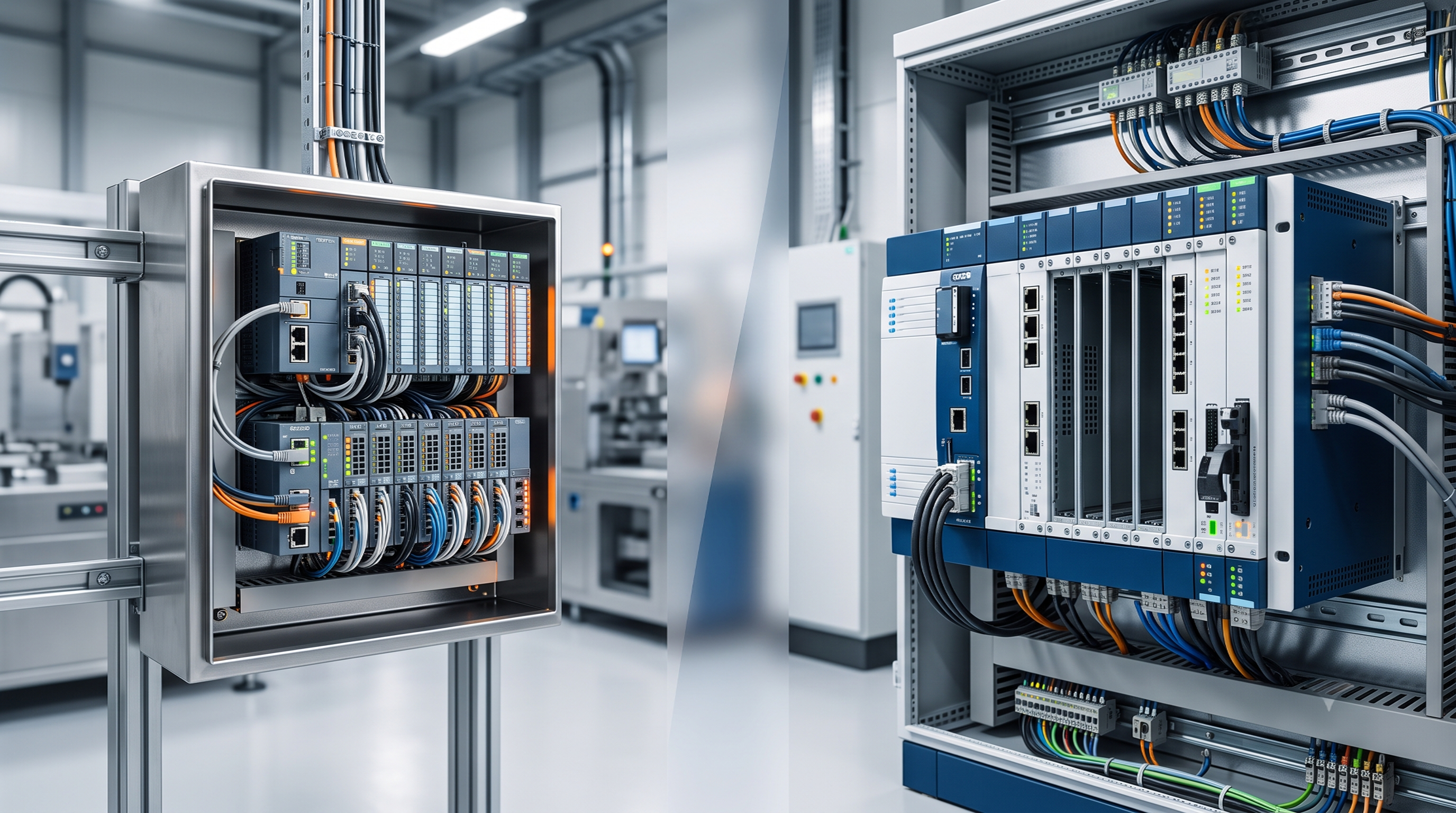
CompactLogix controllers use either a DIN-rail mounted chassis-less structure (like the CompactLogix 5370 and 5380 series) or compact local expansion banks. They use Compact I/O (1769 series) or FLEX 5000 I/O (5069 series) modules that slide together side-by-side without needing a heavy metal rack.

Key Highlights of CompactLogix

  • Compact Footprint: Fits easily into smaller control enclosures and machine panels.

  • Integrated Motion: Controls multi-axis servo motors over EtherNet/IP networks.

  • Cost-Effective: Lower hardware costs compared to full rack-based systems.

  • Integrated Safety Options: GuardLogix models combine standard control and safety control in one unit.

What is Allen-Bradley ControlLogix?

The ControlLogix family is Rockwell Automation’s premier, large-scale control platform built for heavy industrial processes. Think of ControlLogix as a heavy-duty industrial locomotive. It is built to pull massive loads, handle extreme demands, and run continuously without stopping.

ControlLogix systems rely on a physical chassis, also called a rack (1756 series). This rack contains a high-speed backplane. The backplane is a circuit board inside the chassis that allows multiple processors, communication cards, and I/O modules to talk to each other simultaneously.

Key Highlights of ControlLogix

  • Chassis-Based Architecture: Uses heavy 1756 racks with up to 17 slots.

  • High-Speed Execution: Designed for high-density I/O, fast process loops, and complex batch systems.

  • Full Redundancy Support: Supports dual hot-standby CPUs for zero-downtime applications.

  • Multiple Processors: Allows you to install more than one CPU card inside a single rack.

Key Differences: Allen-Bradley CompactLogix vs ControlLogix

While both systems run Studio 5000 Logix Designer software, their hardware capabilities differ significantly.

Feature / Specification Allen-Bradley CompactLogix Allen-Bradley ControlLogix
System Architecture Chassis-less or compact rack expansion Heavy 1756 chassis (rack-based)
Target System Size Small to medium machines Large plants and process systems
Max I/O Points Up to several thousand local/remote points Tens of thousands of points
Multiple Processors Single CPU per local system Multiple CPUs in one chassis
Hardware Redundancy Not supported (no dual hot-standby) Fully supported (1756-RM2 modules)
Removal Under Power (RIUP) Limited on local expansion Fully supported on all 1756 slots
Typical Cost Moderate to cost-sensitive Higher capital investment

1. I/O Capacity and Expansion

CompactLogix handles local I/O banks alongside remote ethernet I/O drops. It easily manages a few hundred to a couple thousand I/O points. ControlLogix, however, is built for scale. A single ControlLogix processor can control tens of thousands of I/O points across giant factory floors.

2. Hardware Redundancy and Reliability

In critical industries like oil refining or water treatment, a controller failure can cause dangerous spills or costly plant shutdowns. ControlLogix supports true hot-standby hardware redundancy. You can place two identical CPUs in separate racks linked by a fiber-optic redundancy module. If the main CPU fails, the secondary CPU takes control in milliseconds without interrupting the process. CompactLogix does not offer hot-standby redundancy.

3. Removal and Insertion Under Power (RIUP)

ControlLogix modules support full RIUP. This means you can pull out a failed input card or communication module and insert a new one while the rack stays powered up and running. Most local CompactLogix expansion modules do not support pulling cards under power.

Practical Use Case: Selecting the Right Platform

Let us look at two real-world factory scenarios to see how engineers choose between these controllers.

Scenario A: High-Speed Packaging Machine

An original equipment manufacturer (OEM) builds a standalone box-packing machine. It needs 32 digital inputs, 24 digital outputs, 4 axes of servo motion, and an touch HMI screen.

  • The Choice: CompactLogix 5380. It offers built-in motion over Ethernet, plenty of speed, a small footprint, and low cost. ControlLogix would be unnecessary and too expensive here.

Scenario B: Municipal Wastewater Treatment Plant

A city water facility controls multiple pumping stations, chemical dosing tanks, aeration basins, and emergency generators. The plant operates 24/7 and cannot afford an unplanned shutdown.

  • The Choice: ControlLogix 5580 with Redundancy. It handles thousands of field devices, connects seamlessly across plant networks, and provides automatic dual-CPU failover to protect plant operations.

Common Selection Mistakes and Engineering Tips

Avoid these frequent mistakes when evaluating your control architecture.

Over-Specifying Small Machines

Installing a ControlLogix rack on a simple standalone machine drives up panel costs and wastes enclosure space. If you do not need hardware redundancy or multiple CPUs, a modern CompactLogix controller delivers the same programming code support at a fraction of the cost.

Underestimating Future Expansion

Choosing a lower-end CompactLogix model without checking its maximum node limit can lock you in a corner. Ethernet nodes include HMIs, variable frequency drives (VFDs), and smart overload relays. Always select a processor with extra node capacity for future machine additions.

Forgetting Module Power Calculations

When building CompactLogix system banks, always check your Power Expansion Modules (1769-PA4 or 5069-FPD). Adding too many expansion cards on one side of the processor without extra bus power will trip backplane power faults.

Conclusion

Understanding the differences in this Allen-Bradley CompactLogix vs ControlLogix comparison ensures you pick the best tool for your plant floor. CompactLogix delivers exceptional speed, motion control, and value for standalone machines and mid-sized systems. ControlLogix offers unmatched power, hot-standby redundancy, and scaling for large industrial process plants.

Do you need help sizing an Allen-Bradley controller or choosing expansion modules for your project? Leave a comment below or reach out to our engineering team at plchub.in today!

Frequently Asked Questions (FAQ)

Can CompactLogix and ControlLogix communicate with each other?

Yes. Both platforms use the CIP (Common Industrial Protocol) over EtherNet/IP networks. They can exchange data seamlessly using produced/consumed tags or explicit MSG (Message) instructions.

Do CompactLogix and ControlLogix use the same programming software?

Yes. Both processor families are programmed using Rockwell Automation’s Studio 5000 Logix Designer (formerly RSLogix 5000) software environment.

What is the main difference between CompactLogix 5370 and 5380 series?

The CompactLogix 5380 is a newer generation processor family. It features faster processing speeds, dual configurable gigabit Ethernet ports, higher node counts, and uses 5069 Compact 5000 I/O modules instead of 1769 I/O.

When should I choose ControlLogix over CompactLogix?

Choose ControlLogix when your application requires full hot-standby CPU redundancy, multiple processors in one rack, very high I/O point counts, or module replacement without shutting down main cabinet power.

← Back to All Articles

Compare 0/4

Side-by-side specs
Compare Now